Save 5% on your first lesson

Kids hate golf? really?
“Does your child dislike golf… or do they dislike the loneliness of practicing it?”
Eddy T.
2/27/20261 min read
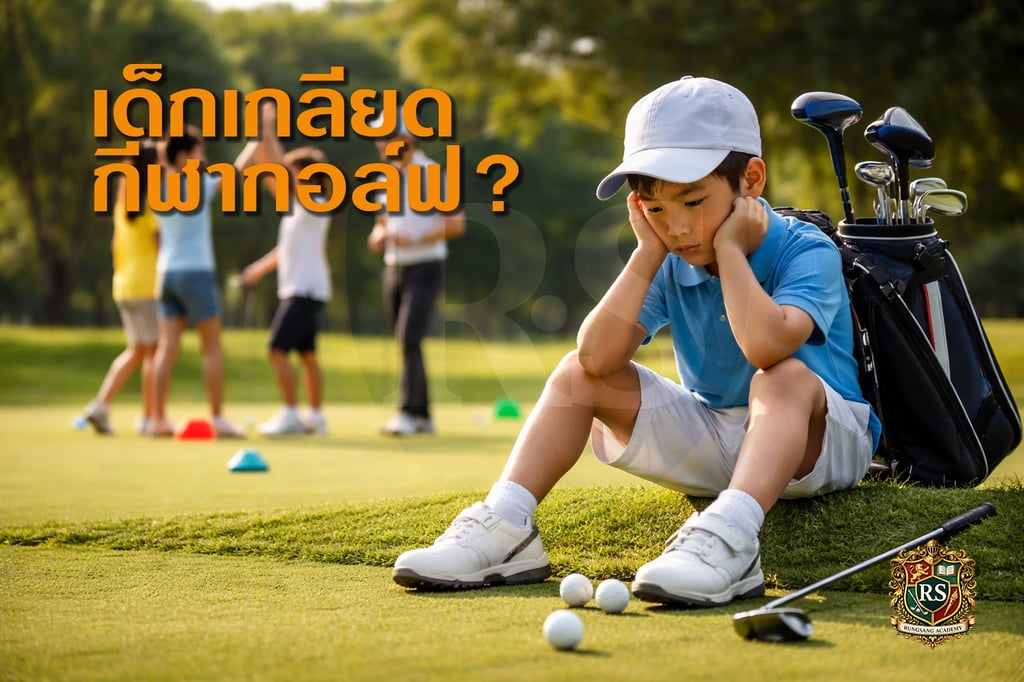
As adults, we see golf as a wonderful sport —
disciplined, character-building,
and full of long-term opportunity.
.
But have we ever truly asked how a child feels?
standing alone on the range for an hour?
.
Golf is one of the best sports
to start at a young age.
.
Yet from a child’s perspective,
practice can feel quiet,
repetitive, and lonely.
.
Neurologically, this makes sense.
.
The prefrontal cortex — responsible for focus,
decision-making, and impulse control —
is still developing in children.
.
Meanwhile, the amygdala,
the emotional center of the brain,
is more dominant.
.
That means children naturally
seek stimulation,
connection, and excitement.
.
Now add today’s environment —
screens, fast-paced content,
constant dopamine stimulation.
.
Asking a child to practice alone,
in silence, competing against YouTube
or mobile games,
is an uphill battle.
.
Most children don’t dislike golf.
.
They dislike boredom.
They dislike isolation.
They need friends.
They need positive competition.
.
They need structured challenges
that match the excitement level
of their generation.
.
When kids practice in a
well-designed small group:
.
Focus lasts longer
Motivation increases
Emotional resilience improves
Skills develop faster
.
This is why RS Academy runs structured
Small Group Performance Classes
instead of isolated one-on-one sessions.
.
What works better?
✔ Structured group dynamics
✔ Friendly competition
✔ Shared goals
✔ Team energy
✔ Visible progress within a peer group
.
It’s not just about swing mechanics.
.
It’s about creating an environment
where children want to practice.
.
Our pathway system has proven effective
in developing Thai junior golfers
who have progressed to
international levels —
not by training alone,
but by training within
a performance culture.
.
So the real question is not:
“Why is the course premium if it’s not one-on-one?”
.
The better question is:
Do you want your child practicing alone…
or growing in an environment
that makes them love the game —
and rise beyond it?
Contact
Reach out anytime for bookings or questions
Phone
+66-8-0097-4878
© 2026. All rights reserved.